Kibrom Demoz.
Writer · Poet · FilmmakerEritrea / Germany

Kibrom
Demoz.

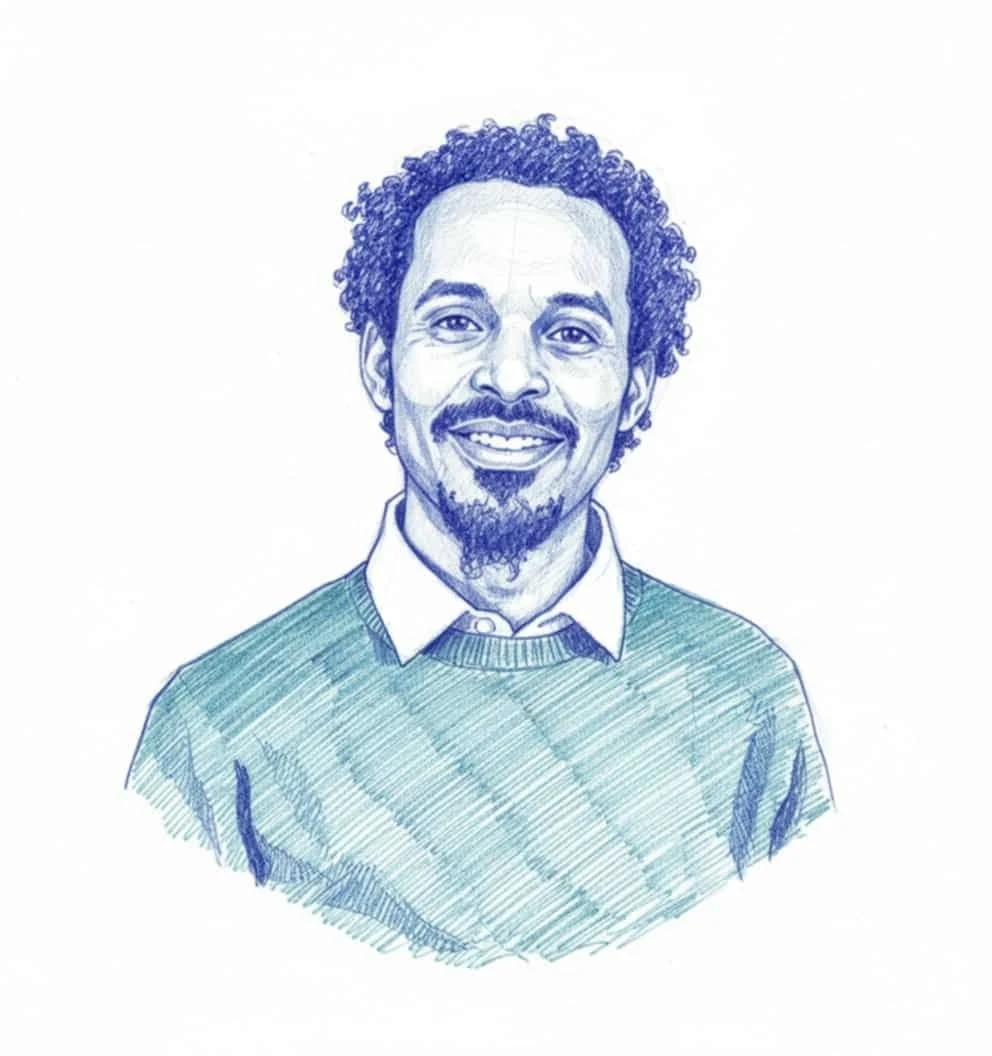
Kibrom Demoz — hand-drawn portraitArt · Memory · Freedom
A voice from Eritrea

Giving life a voice through words.

Writer, actor, filmmaker, translator and poet. Kibrom Demoz writes about homeland and longing, war and humanity, loss and the freedom to shape one’s own life.

Discover his story
01 / About the author

A life devoted
to art.

For Kibrom Demoz, art was never just a profession. It was a way of understanding the world — and telling his own story.

Growing up in a large family in Eritrea, he developed an early love of literature, acting and theatre. At school, in Asmara and beyond, he was involved in theatre, film and radio, and worked as a translator, broadcaster and freelance journalist.

As a veterinarian, he cared for animals and supported rural communities. Military service, war and injury shaped his understanding of violence, responsibility and the value of life. He fled through Sudan and across the Mediterranean to Germany.

In Germany he encountered racism, discrimination and a lack of recognition for his knowledge and professional experience. At the same time, he worked to support others through social work, counselling and community engagement. Literature became a place where he could explore these contradictions.

Theatre & FilmLiterature & TranslationRadio & JournalismVeterinary & Social Care
Read the full biographyClose the full biography

Between belonging, dignity and new beginnings

Childhood, language and art

Kibrom Demoz was born into a large family in Eritrea. From childhood, he was drawn to storytelling, reading and acting. His school years and encounters with theatre opened creative spaces for him. He performed, contributed to films and audio productions, and discovered how art could express personal experiences and illuminate social questions.

A creative life in Eritrea

His activities took him beyond school into the cultural life of Asmara and other parts of Eritrea. Theatre, film, broadcasting, freelance journalism and translation were not separate pursuits for him: each centred on language, listening and the possibility of reaching people with different experiences.

Veterinary medicine and respect for life

Alongside his artistic passion, Kibrom worked as a veterinarian. Caring for sick animals, helping farming families and assisting new life deepened his sense of responsibility. Whether a dog, an ox or a newborn lamb, he believed every living being deserved care. He saw this as part of a wider commitment to dignity, compassion and the freedom to grow.

War, coercion and the decision to flee

Military service, experiences of war and injury confronted him with power, violence and years of life taken away. He increasingly saw war as a machine whose consequences fall most heavily on young people and families. Restrictions on his personal and professional autonomy ultimately contributed to his dangerous journey through Sudan and across the Mediterranean to Europe.

Germany: arriving yet remaining unseen

He arrived in Germany hoping for freedom, safety and recognition. Instead, he found that his education, artistic work and life experience often disappeared behind the label “refugee”. Racism, discrimination and the failure to recognise existing skills made integration a struggle for visibility and equal participation.

The contradiction of care

One contradiction was especially painful to him. In Eritrea, he had treated animals with patience and compassion, working to meet their basic needs. In Europe, where he expected a strong commitment to human rights and dignity, he sometimes felt he received less care than he had given to animals. This experience became a central question in his poetry: to whom do compassion, dignity and the right to self-determination truly apply?

History, culture and Eurocentric perspectives

Kibrom challenges the idea that knowledge and civilisation originated exclusively in Europe. He points to the long traditions of writing, language, storytelling and learning in the Horn of Africa, as well as knowledge handed down across generations in families, villages and cities. His pointed comparisons of African and European historical narratives form part of his critique of colonial continuities and Eurocentric superiority — the author’s perspective, not a blanket judgement of entire cultures.

Community, counselling and social work

In Germany, Kibrom also became involved in social work, counselling and support within his community. Through conversation, guidance in everyday life and sharing his own experiences, he sought to offer others what he himself had often lacked: a listening ear, respect and practical help. This work deepened his reflections on solidarity, belonging and living between languages and societies.

Literature as an answer to silence

Experiences of exclusion, memories of Eritrea and the search for a dignified life flow into his poems. He writes not only of loss but also of love, family, animals, hope and the possibility of remaining humane despite disappointment. His art resists silence and gives shape to experiences that extend beyond his own biography.
02 / Poems and reflections
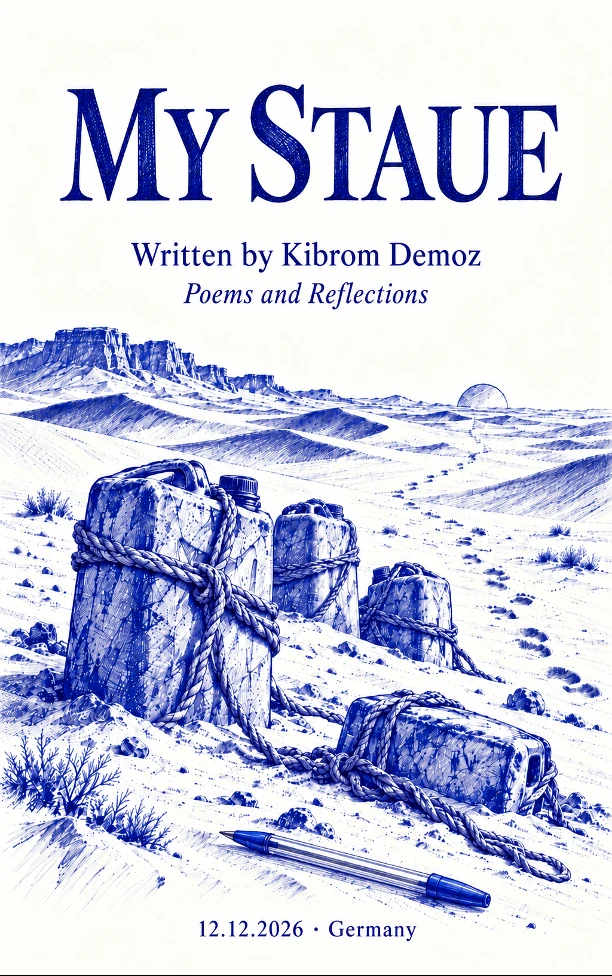
Book cover: My Staue — Poems and Reflections by Kibrom Demoz

My Staue

Poems and Reflections

In his book, Kibrom Demoz looks back at the hopes of a generation, the love of homeland, and the painful ruptures of war, oppression and exile.

The poems ask about dignity, family, identity and what remains when a beautiful dream goes unfulfilled.

ኣነ ዝምነዮ፡ …
ብግጥሚ ጥራይ ክኾነለይ እምነ።

From a Tigrinya text supplied by the author.

View cover
Read more about the bookClose the book description

A book about memory and carrying on

“My Staue” brings personal memory together with collective experience. Its poems and reflections explore the distance between what people dream of and what history, political power and displacement make of those dreams.

The unfulfilled promises of independence

The supplied text “A translator’s reflection…” describes Eritrea as a country marked by extraordinary sacrifice and hope. In this reading, the poems carry the pain of a generation that believed in freedom and dignity, only to find many of its hopes frustrated after independence. Pride in the past and bitterness toward the present exist side by side.

Poetry as testimony

Kibrom’s writing preserves experiences that might otherwise be lost: war and coercion, separation from loved ones, the dangers of flight, and the feeling of not being seen as a whole person. The poems are both lament and testimony. They speak to individual vulnerability while recalling shared destinies.

Homeland, language and imagery

In the supplied Tigrinya text “ኣነ ዝምነዮ፡” (“What I wish for”), the poetic voice longs to shape images of homeland, nature, parents, memory and inner contradictions through the language of poetry. Language is more than a medium of expression: it is a space in which what has been lost can be preserved.

The sea, loss and exile

The sea becomes a complex presence in the poem: it can evoke home and longing, but it also recalls those who have died along routes of escape. Exile here means more than a change of location. It affects language, self-image, relationships and the question of who is allowed to tell one’s story.

Love, humanity and self-determination

Alongside protest, the book makes space for tender and philosophical questions: What makes a good life? What do we owe one another? How can love, care and freedom survive violence and disappointment? These themes connect Kibrom’s experience as an artist and veterinarian with his work supporting people in his community.

This description draws on the supplied Tigrinya excerpt and the translator’s English reflection. It is a thematic interpretation, not a complete account of every poem in the book.

03 / Themes in his writing

What moves him.

01 /

Homeland

A lasting bond with Eritrea, its people and its memories.

02 /

War & Memory

The marks of war and the worth of every single life.

03 /

Exile & Identity

Between origins and arrival: searching for belonging and dignity.

04 /

Love & Freedom

Compassion, human relationships and the right to self-determination.

04 / Contact

Stay in touch.

For readings, cultural projects, translation and conversations about literature.

Contact details can be added here.